 |
|
|
|
|
| |
|
News
media,
September 15, 2002
|
|
|
| |
|
Imagine that digital and analog media continue to converge (think of
the web and of digital TV). Multimedia databases are used to provide
news and other content on demand. News production is even more globalized,
but at the same time localized: people still want news concerning their
neighborhood.
The movie News media, September 15, 2002 illustrates one such scenario.
|
|
|
|
Interaction
on the bus

|
|
|
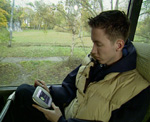
Jocke, 16, is on the bus home from Malmö to Ystad. He spends
the trip visiting his preferred news service EdgeWARE on his PDA.
|
|
|
|
|
|
Interaction
in kitchen
|
|
|
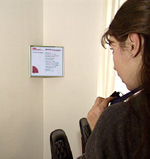
Anna is Jocke's mother. She is single with two children and works
full-time. An active community member, she is interested in news:
regional and national as well as global. She subscribes to CNM
Österlen, a news service with a strong reputation for quality
and good local coverage. By using personalized news filters and
watching news magazines, she manages to stay reasonably updated.
|
|
|
|
|
| |
|
|
Jocke comes into the kitchen and zaps the kitchen-wall screen
with his PDA, to pick up where he left off on the bus. Anna throws
him out and continues to listen to her news while cooking.
|

|
|
|
|
|
Interaction
in the
living room
|
|
|
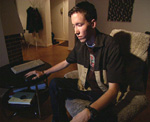
Jocke turns to the living-room screen, using the PDA as a pointing
device to publish an item from EdgeWARE on his own news site.
In his own sub-culture (cyber/hardcore), he is very active; not
only does he consume large amounts of news, but he also produces
his own news service in Swedish for a local following. However,
he has chosen to ignore traditional sources such as the morning
paper and his mother's preferred news magazines.
|
|
|
|
|
| |
|
|
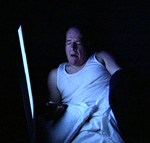
Erik lives right across the street from Anna and her children.
He is an avid news consumer - eight hours a day is not unusual.
However, his idea of news consists in the major soccer leagues
in most European countries. It is not hard for him to find such
"news". He doesn't even have to pay for it as long as he puts
up with 25% commercials.
|
|
|
|
|
| |
|
Explorative assessment
Eight people were interviewed about their news habits and their reactions
to the movie. The results show that news-on-demand services are not
seen as very valuable in themselves. People find value in professional
journalistic/editorial work. The external prompting implied by fixed
starting times for TV news shows, the arrival of the morning paper,
etc., is an important part of the everyday news routine.
Our conclusion from the study is that we should concentrate further
efforts in the following directions.
 Support news routinization:
news shows for general overview and individual follow-up, adjustable
news summaries for travel, exploring brand value in digital media, etc.
Support news routinization:
news shows for general overview and individual follow-up, adjustable
news summaries for travel, exploring brand value in digital media, etc.
Address the technology-induced distinction between volatile
and persistent information by exploring use qualities of tangible digital
media.
Explore new formats and contents
for news in digital media: public hearings, multiple perspective attractors,
niche news agencies, etc.
Credits
Jacqueline Bonneau, Jonas Löwgren, Anders Möller, Åsa
Rudström, Annika Waern.
|
|
|
| |
|
 |
|
|